
How to get a spare part that is no longer made
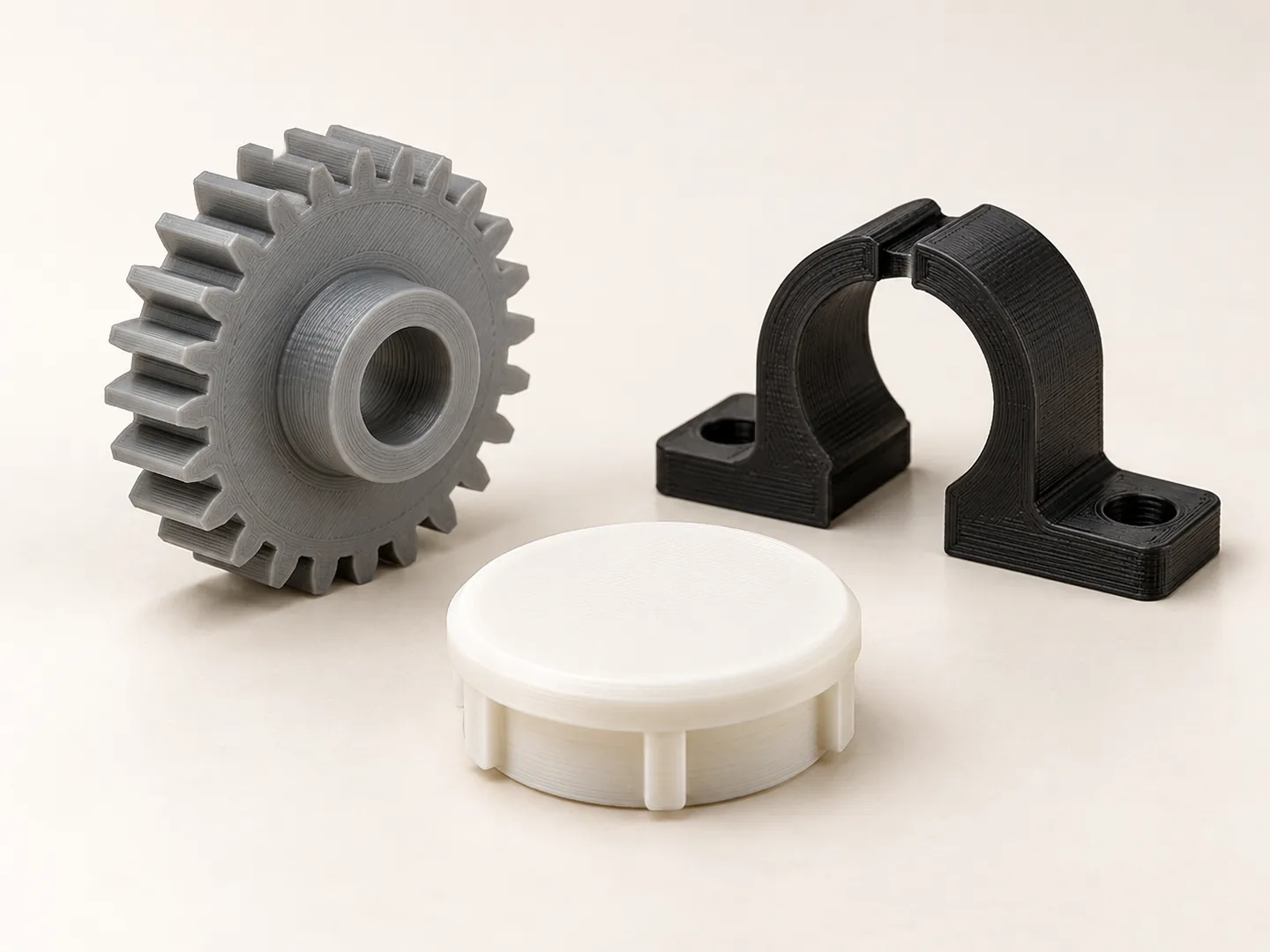
Short answer: if the manufacturer no longer sells the part, it can be reproduced by 3D printing from the broken part or from photos with measurements. For small plastic parts —clips, covers, gears, brackets, knobs— printing usually costs €6 to €30, plus design if there is no file (from €28), and takes 3–5 days.
Which spare parts can be printed?
Plastic parts that do not carry extreme loads work very well:
- clips and tabs from appliances, furniture and car panels;
- covers, trims, knobs and buttons;
- small gears from blinds, toys and blenders;
- brackets, clamps and spacers;
- rubber-like seals and stops (in flexible TPU).
Some real jobs from our workshop:
| Part | Purpose | Material |
|---|---|---|
| Baby stroller part | replace a broken part no longer sold | PBT, engineering plastic (on request) |
| Flexible jaws for a tablet holder | hold the tablet without scratching it | TPU |
| Roof vent pass-through | fit the pipe to a non-standard angle | PETG |
| Seal drivers for motorcycle forks | custom workshop tool | PETG |
As you can see, it is not always about copying a part: sometimes it is a part that never existed, made to fit the exact problem.
Which parts should not be printed?
- Safety parts: brakes, airbags, seat belt anchors, child car seats, helmets.
- Parts exposed to high heat: next to an engine, ovens, hair dryers.
- Parts in continuous contact with food.
- Parts carrying large loads whose failure could injure someone.
In these cases we look for the original spare part or suggest another solution.
The process, step by step
- You send us the part or photos. Photos from several angles, with a ruler or calipers next to it, and if possible the part from the other side (many parts have a mirror twin that is still intact).
- We measure and design in CAD. We reproduce the geometry and, if the original always broke in the same place, we reinforce it: thicker walls, rounded corners, another material.
- We print a first version and test it, or send it to you to try in the device.
- We adjust if needed. One or two tenths of a millimetre can decide whether a clip fits; adjustments are included.
- You keep the file if you like: next time you only pay for printing.
How much does it cost and how long does it take?
| Part of the job | Guide price | Lead time |
|---|---|---|
| CAD design of a simple part (clip, cover) | from €28 | 1–2 days |
| Design of a complex part (gear, enclosure) | €100–300 | 2–4 days |
| Printing a small part (up to 20 g) | €6 | 24–72 h |
| Printing a medium part (≈ 100 g, PETG) | ≈ €21 | 24–72 h |
Design is charged separately from printing, at about €25–45 per hour (VAT included) depending on complexity; we give you a fixed price in writing before we start. If you already have the 3D file (for example, from a model website), go straight to the calculator.
Which material for a spare part?
- PETG for most spare parts: tough, handles humidity and about 70 °C.
- ASA for car, outdoor or sun-exposed parts.
- TPU for seals, stops and parts that need to bend.
- PLA only for indoor parts under no stress, or for a first fit test.
More detail in PLA or PETG: which to choose.
How to start
Message us on WhatsApp with 3–4 photos of the part and a ruler next to it, or with the main measurements. We reply with price and lead time in writing. If you are not sure how to measure the part, see how to measure a broken part. More about the service on spare parts.