
PBT 3D printing: the plastic that ignores oil and moisture
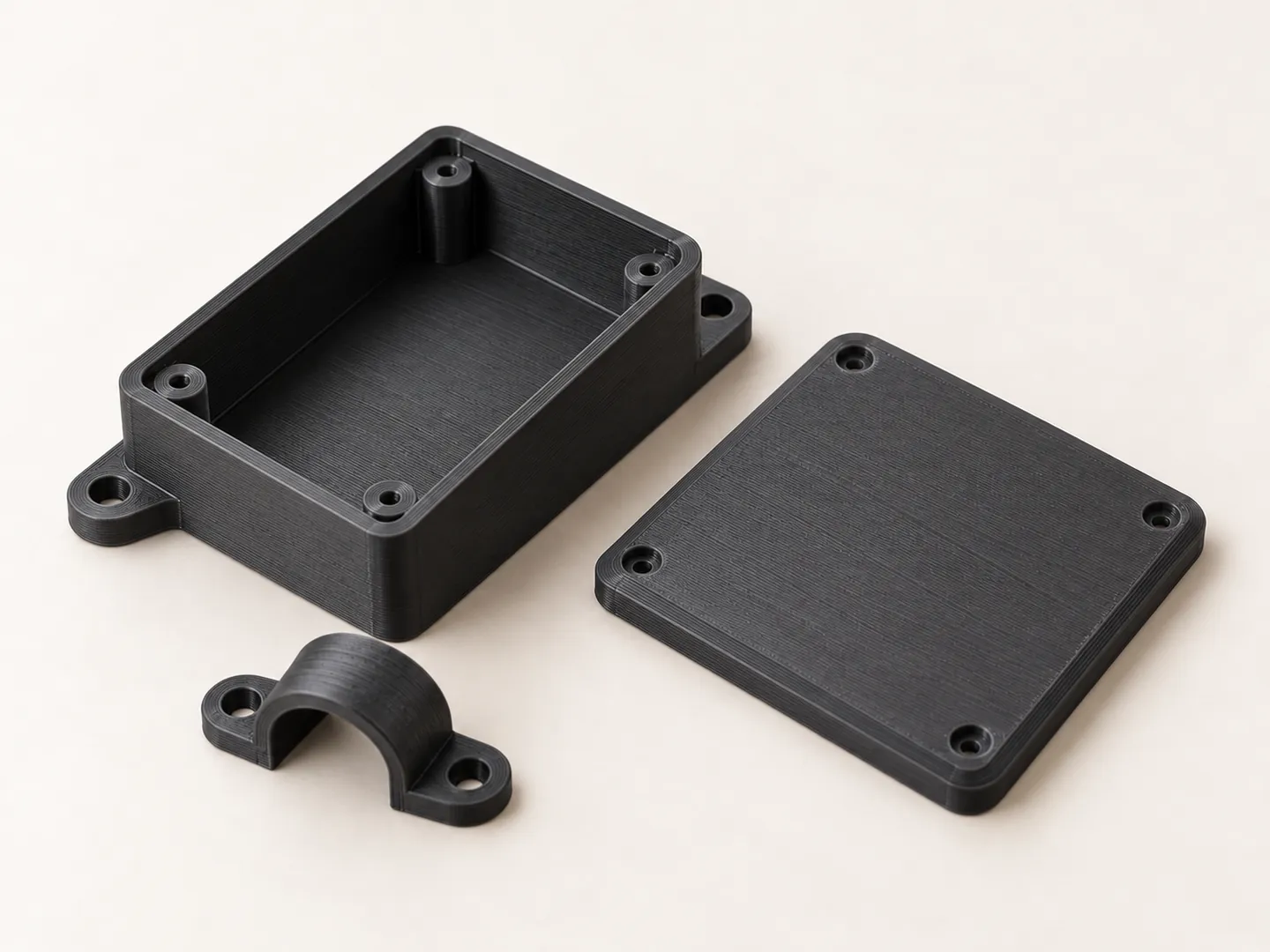
Short answer: PBT is an engineering polyester that keeps its size, barely absorbs water and resists oils, fuels and solvents. It takes more heat than PETG and is a good electrical insulator. It is the choice for electrical housings, engine bay parts and parts that must fit the same in summer and winter. If the part has to bend or take hard impacts, nylon is better.
Where you have seen it
PBT is one of the most widely used engineering plastics: electrical connectors, switch housings, headlamp and engine parts, and the keycaps of good mechanical keyboards. It is chosen for the same reasons that matter in 3D printing: stability, chemical resistance and insulation.
PBT vs PETG and nylon
| PETG | PBT | Nylon (PA) | |
|---|---|---|---|
| Heat deflection (HDT, 0.45 MPa) | ≈ 70 °C | ≈ 105 °C; with glass ≈ 170 °C | ≈ 110 °C; with fibre 180–190 °C |
| Water absorption | low | very low | high |
| Holds its size | well | very well | so-so when humid |
| Oil and fuel | fair | excellent | good |
| Wear and friction | fair | good | excellent |
| Impact toughness | good | medium | very high |
| Electrical insulation | good | very good | good when dry |
Typical datasheet values: Polymaker PC-PBT 107 °C, PolyMide CoPA 111 °C. Pure PBT is rarely sold as filament: the usual options are PC-PBT or glass-filled PBT. As a reference for glass-filled PBT, Flashforge lists for its PBT-GF a heat deflection temperature of 175 °C at 0.45 MPa, 65–70 MPa tensile strength and under 0.4 % water absorption in 24 h.
When to choose PBT
- Electrics and electronics: boxes, board mounts, junction covers. It insulates and does not change with humidity.
- Cars, motorbikes and machinery: parts splashed with oil, petrol or brake fluid that also get hot.
- Fits that must last: covers and parts with tight tolerances in damp places, where nylon would swell.
- With glass fibre (PBT-GF): when you need more stiffness and heat without losing chemical resistance.
What to know
- It is harder to print than PETG: about 260–280 °C at the nozzle, a 100–120 °C bed and an enclosed printer. We print it on the Bambu Lab P1S.
- It is dried before printing, even though it absorbs little water: a few hours in an oven at about 80 °C.
- It is not flexible. Long-travel clips and living hinges are better in nylon or PETG.
- For years in the sun, ASA is better, as it is designed for UV.
How to order
PBT is not in the calculator: we quote it separately depending on the part and whether it has fibre. Send the file or photos with measurements on WhatsApp and tell us where it will work: temperature, fluids and loads. More on the PBT, nylon and glass fibre pages.