
Carbon fibre or glass fibre in 3D printing: when it is worth it
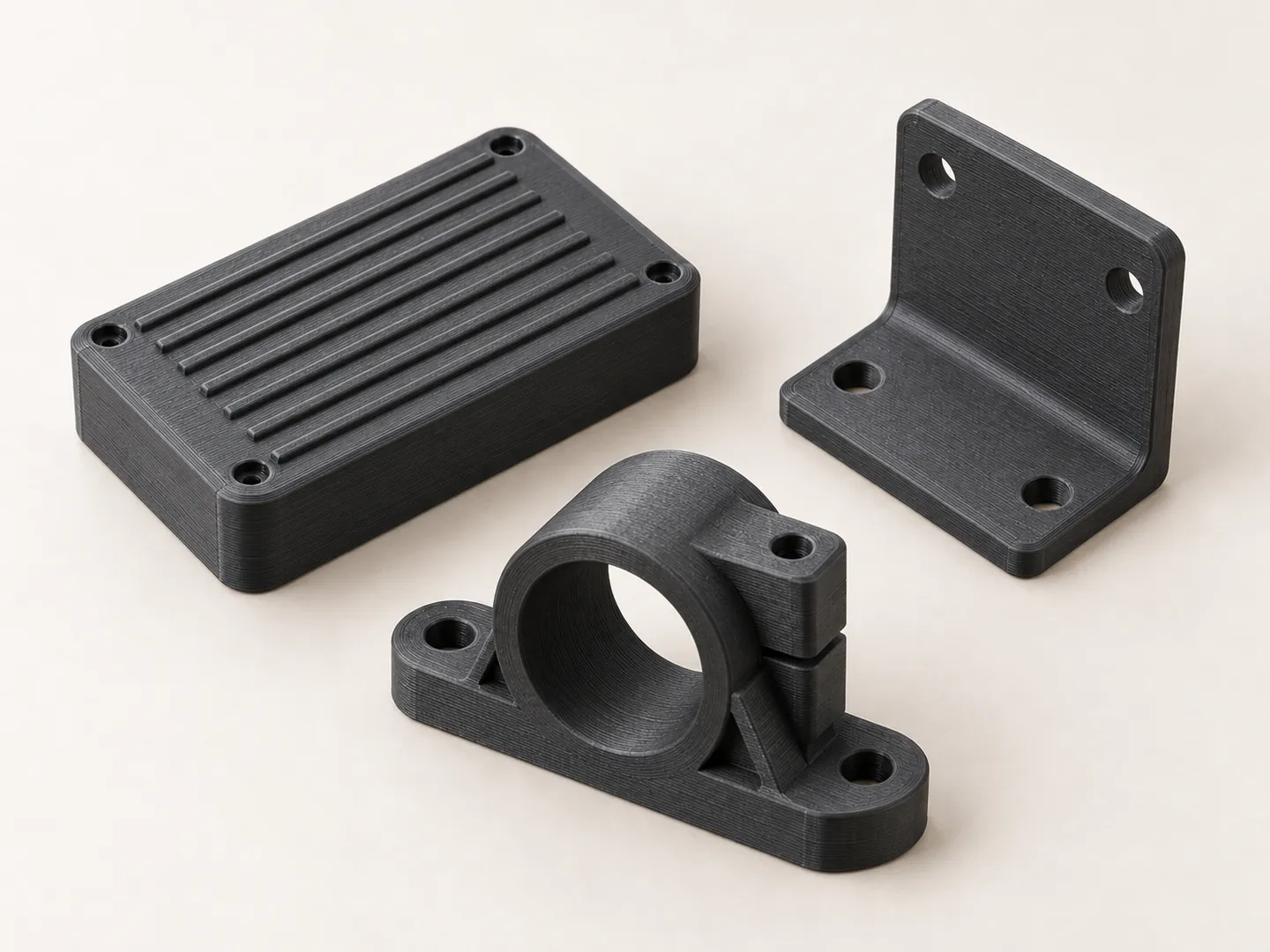
Short answer: fibre makes a part stiffer and more dimensionally stable, not stronger in every way. Choose carbon fibre (CF) if the part must not flex and weight matters: brackets, arms, jigs, drones. Choose glass fibre (GF) if it also takes impacts, must insulate electricity or the budget matters. If the part has to bend, like a clip or a snap fit, go without fibre.
What a “fibre filled” plastic is
It is a normal filament (PLA, PETG, nylon, ABS, PBT) with very short carbon or glass fibres mixed in, usually 10–25 %. The fibres line up with the nozzle path and work like the rebar in concrete: the part bends less under load and shrinks less as it cools, so it warps less and holds its size better.
The name says it all: PLA-CF is PLA with carbon, PA-GF is nylon with glass. Fibre improves stiffness, but the base plastic still sets the heat and chemical limits. A PLA-CF softens at the same 55 °C as plain PLA (Bambu Lab PLA-CF HDT: 55 °C).
Carbon or glass: the differences
| Carbon fibre (CF) | Glass fibre (GF) | |
|---|---|---|
| Stiffness | highest | high |
| Weight | lighter | slightly heavier |
| Impacts | more brittle | handles them better |
| Electricity | may conduct slightly | insulating |
| Finish | dark matte, hides layers | matte, slightly rough |
| Colours | almost always black | several |
| Material price | higher | lower |
Which base to choose
- PLA-CF: the easiest and cheapest. Indoor jigs, templates and stiff parts that do not get hot.
- PETG-CF: a bit more heat (74 °C HDT for Bambu Lab PETG-CF) and better with moisture. Brackets, housings and workshop parts.
- PA-CF and PA-GF (nylon): the truly technical ones. They handle heat, oil and wear. For example, Bambu Lab PAHT-CF is rated at 194 °C heat deflection (0.45 MPa) and 92 MPa tensile strength (manufacturer data).
- ABS-GF and PBT-GF: when you need stability and heat without nylon (HDT: Bambu Lab ABS-GF 99 °C, PBT-GF ≈ 170 °C; PA6-GF reaches 182 °C); PBT also resists fuels and does not absorb water.
What nobody tells you
- Stiffer is not stronger in every way. With fibre a part bends less but breaks sooner under a sharp impact. A plain PETG clip can outlast a PETG-CF one.
- Parts are weaker between layers than along them. We orient the part so the load runs along the layers, which sometimes changes the lead time or supports.
- It wears the machine. Fibres are abrasive and a standard brass nozzle does not last. We print these materials on the enclosed Bambu Lab P1S with a hardened steel nozzle.
- Nylon must be dried. It absorbs moisture from the air; printed wet it comes out porous and weaker. We dry it before every job.
When is it not worth it?
If the part stays indoors, does not get hot and carries no real load, plain PETG is usually enough and costs less. Fibre has a price: PA-CF filament costs several times more than PETG and prints more slowly.
How to order a fibre part
These materials are not in the calculator: the price depends a lot on the base and on how the part works. Send us the file or photos with measurements on WhatsApp, tell us the load, the temperature and whether it takes impacts, and we will recommend the material with price and lead time.
More in the carbon fibre, glass fibre and nylon pages.