
Nylon (PA) 3D printing: gears, bushings and parts that rub
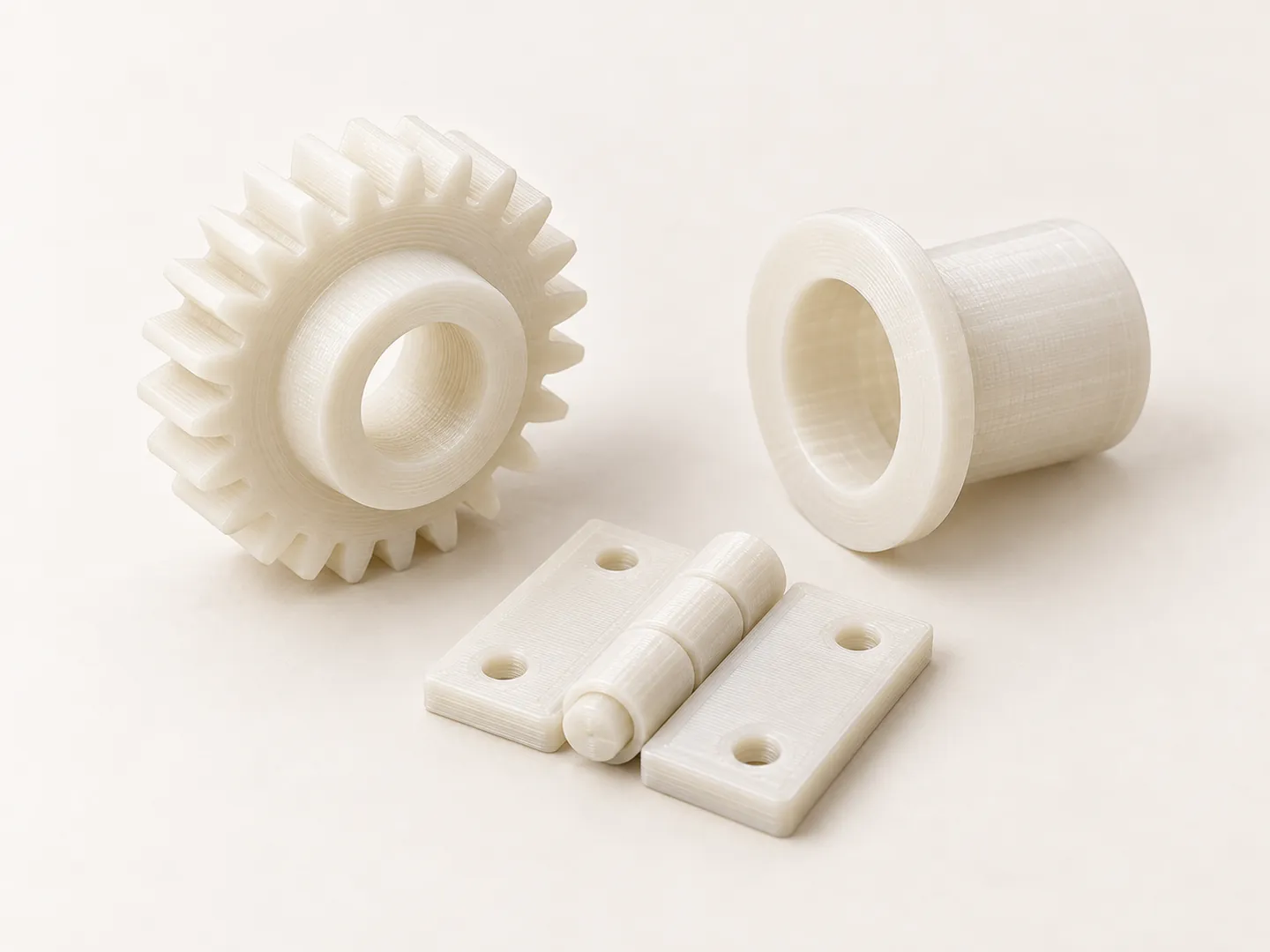
Short answer: nylon (PA) is the material for parts that rub, turn or flex many times: gears, bushings, guides, hinges, clips. It is tougher than PETG, resists wear, oil and petrol and takes more heat. In exchange it absorbs moisture and costs more. If the part only has to hold something at home, you do not need it.
Why nylon
- Wear. A PLA or PETG gear chews its teeth in weeks if it works often. Nylon has low friction and a surface that polishes with use instead of wearing away.
- Toughness. It deforms before it breaks. A nylon living hinge or clip survives thousands of cycles.
- Oil and fuels. It resists grease, oil and petrol: machine, motorbike and tool parts.
- Temperature. It takes more heat than PETG: an unfilled nylon such as PolyMide CoPA is rated at 111 °C HDT at 0.45 MPa, against about 70 °C for PETG. With carbon fibre (PA-CF) it goes much higher: Bambu Lab PAHT-CF is rated at 194 °C heat deflection at 0.45 MPa (data).
PA6, PA12 and fibre versions
| Good for | Watch out | |
|---|---|---|
| PA6 | toughest, good wear | absorbs more moisture |
| PA12 | more stable with moisture | slightly less stiff |
| PA-CF (carbon) | stiff, stable, high heat | more brittle, black only |
| PA-GF (glass) | stiff and tough, insulating | heavier |
For PAHT-CF (PA12 with carbon), the manufacturer states 0.88 % water absorption at saturation versus 1.70 % for standard PA-CF, and a 12–18 % loss of properties when wet versus 40–45 %. That is why we prefer PA12 for parts in humid places.
The moisture problem
Nylon absorbs water from the air within hours. Printed wet, the water boils in the nozzle and the part comes out porous, stringy and weaker. So we dry it in an oven at about 80 °C for several hours before printing and store it with desiccant. Once printed, the part takes up some moisture from the air: it becomes slightly more flexible and large parts grow by a few tenths of a millimetre. We allow for that in precise fits.
Design tips
- Gears: module 1 or larger; with very small teeth the advantage of nylon is lost.
- Bushings and shafts: leave 0.2–0.3 mm clearance on the diameter; we tune it with a test piece if needed.
- Living hinges: 0.4–0.6 mm thick where it bends, printed along the layers.
- Threads: nylon takes brass heat-set inserts, far better than threading the plastic.
When not to use nylon
- The part must be very stiff and does not move: PETG-CF or PA-CF is better.
- It must keep an exact size in humidity: PBT is better.
- It will be in contact with food: no printed plastic is a good idea.
How to order
Nylon is not in the calculator: we print it on the enclosed Bambu Lab P1S and the price depends on the PA type and the part. Send the file or photos with measurements on WhatsApp and tell us how the part works. More on the nylon (PA) page and in the article on carbon and glass fibre.